


PART 2: What Happens After Startup: How Technology Choices Drive Performance and Risk in Year 1, Year 5, and Year 15
Most composting projects look good on paper. The real test starts after the ribbon cutting, when the site has to hit production targets week after week, through weather swings, staffing gaps, contaminated loads, and the occasional neighborhood complaint.
This is the second installment in our three-part series comparing the true cost of composting technology decisions over the life of the technology. In Part 1, we explained why composting projects struggle not because composting fails, but because the chosen system cannot consistently perform under real-world constraints. We also highlighted a common mistake buyers make by prioritizing upfront capital cost over long-term outcomes. This month we will run through each system (Open Windrows, ASP, in Vessel, and SG Advanced Composting™ Technology) and identify common operational realities and how different systems behave under day-to-day pressure.
Here is the hard truth that facilities and operators learn quickly: composting technology is not just a processing method. It is a risk profile. The system you choose determines whether common operational stressors remain manageable, or compound into recurring cost, compliance exposure, and reputational damage.
The “Operating Reality” That Drives Risk
Regardless of feedstock or geography, most facilities face the same pressure points once they are running:
- Odor events are episodic, but consequences are cumulative
It often only takes a few bad days to trigger complaints, scrutiny, and more restrictive operating conditions.
- Labor and turnover are not temporary problems
Systems that demand constant attention, frequent material handling, or specialized mechanical skills become fragile when staffing gets tight.
- Stormwater and water management is a compliance issue, not a housekeeping issue
Rain and runoff do more than create a mess. They destabilize recipes, create leachate risk, and complicate permits and inspections.
- Throughput is not a promise, it’s a guarantee.
True throughput depends on the entire system: how much material is sitting in process on the pad, how quickly you can clear space, and how consistently the biology performs.
A good decision reduces sensitivity to these factors. A weak decision makes the whole site dependent on perfect conditions.
How Technology Choices Behave Once the Site Is Running
Below is a practical way to think about the four most common approaches after startup, with a focus on performance consistency and operational risk.
Open Windrow: Low infrastructure and upfront cost, high risk exposure
Windrows can work when land is abundant, setbacks are generous, and neighbors are forgiving.
Once the facility is operating at scale, risk typically shows up as:
- Weather Driven Variability in moisture, temperature, and process control
- Odor Vulnerability because there is no containment, especially during turning and during warm, stagnant conditions
- High Material Handling from frequent turning and extended residence times
- Inventory Pressure as extended processing requires more piles and more pad space
- Rising Operating Costs from fuel use and equipment wear
Windrows are mechanically simple, but they often become operationally complex and financially burdensome when conditions are less than ideal.
Aerated Static Pile (ASP): Improved oxygen, new dependencies
ASP systems reduce turning by pushing air through the piles using blowers and piping. That can improve consistency and reduce labor hours, but it introduces new risks.
Operational risk tends to concentrate in high-cost places:
- Blower Energy Consumption and Maintenance become permanent operating line items
- Air Channeling Through the Pile and Uneven Airflow can reduce consistency, due to airflow following the path of least resistance
- Odor and Emissions Control often relies on biofilters or compost caps, which have their own cost, require their own upkeep and are not a set-it-and-forget-it solution and are unproven in their performance.
- Water Management Requires an expensive roof structure for separation of stormwater from leachate but also requires operators to add water throughout to maintain the correct ratios.
In-Vessel and Tunnels: Containment with High Mechanical and Staffing Demands
In-vessel systems can provide enclosure and process control, but they also shift risk into mechanical reliability and staffing.
The failure modes are different, but they still matter:
- High Capital Cost for Tunnels Large up-front capital investments for tunnels and containment units eat up your budget and increase demand from investors to see ROI quickly.
- Downstream Curing and Handling continued need for curing and downstream handling outside the vessel needs to be planned and resourced, adding cost and time to the process, even if the active phase is shorter
- More Moving Parts means higher maintenance costs and larger consequences when something breaks
- Skilled Staffing Requirements greater reliance on higher paid and highly skilled operators for sensors, controls, and emissions systems as well as the curing and handling outside the vessel
- Water Management Water must be continuously added and managed to maintain the correct ratios, adding operating hours and cost over time
In-vessel can be appropriate in certain applications, but buyers must evaluate the full operating reality, including maintenance culture and staffing capacity, not just advertised timelines.
SG Advanced Composting™ Technology with GORE® Cover (CASP): Higher Reliability, Lower Cost Over the Lifetime of the Facility
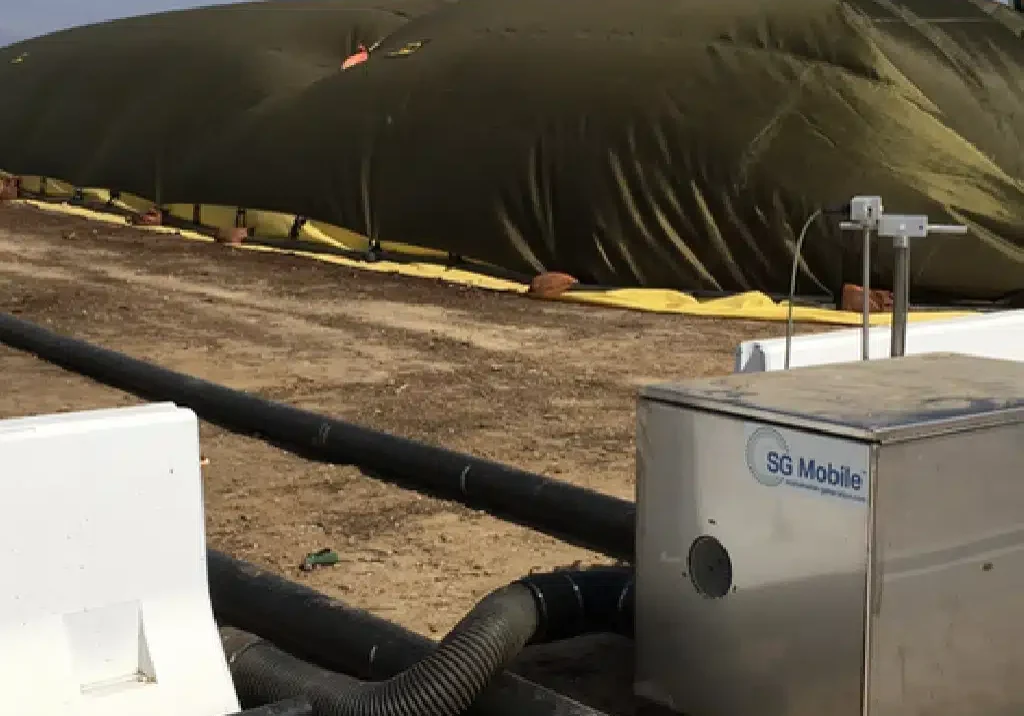
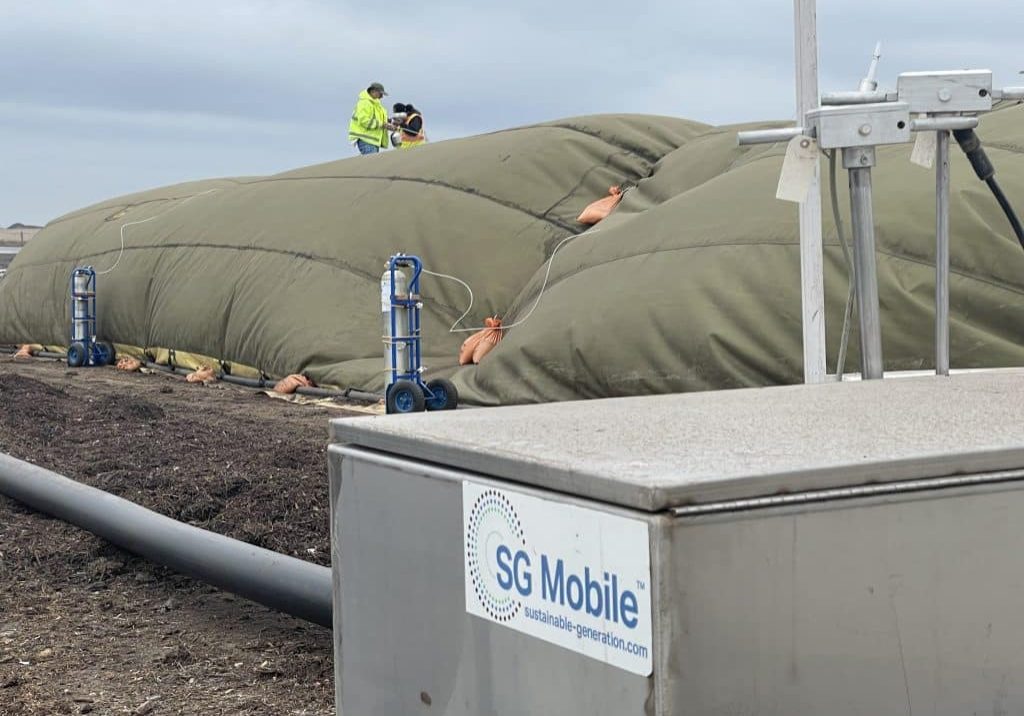
The SG Advanced Composting™ System with Gore® Cover is designed to reduce cost and complexity while reducing operational risk. SG uses a highly engineered, breathable membrane cover that is a pollution control device delivering clean air and clean water by reducing odor and VOC emission and separating stormwater from leachate.
In practice, that means:
- Fewer Odor Incidents and Fewer Operational Surprises due to effective encapsulation during composting and no need for a biofilter or a building
- Moisture Management Becomes a Net Positive because rain stays out and moisture stays in, you no longer need to consistently add water to the piles, lowering labor and material costs
- Less Rework and Handling because the process is repeatable and controlled so you can depend on the results.
- Simplified Compliance Posture that holds up as conditions change
This category is what SG Advanced Composting™ Technology is designed around, specifically to reduce risk once the facilities are operating under real conditions.
A Better Question to Ask Before You Buy
Instead of “Which system is cheapest to build,” ask: Which system keeps the site stable when real-world problems show up?
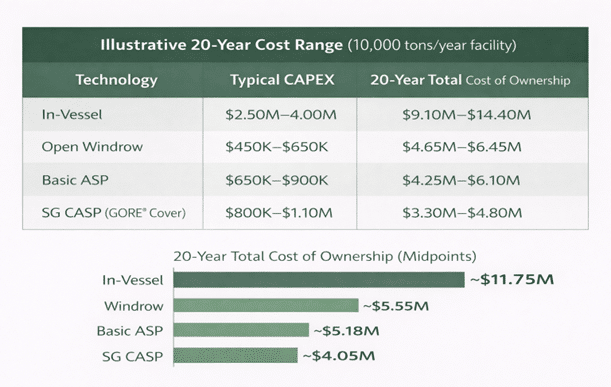
The right system creates resilience by creating repeatable and reproducible results for the facility. It gives owners and operators room to breathe, keeps compliance manageable, and reduces the chance that one bad season turns into a long-term constraint. In the chart below, we show you an illustration of a typical cost of ownership over 20 years.
Next Month: The Differentiator That Changes the Risk Profile
In the final installment, we will explain why engineered covers are not an accessory. They are a core performance and compliance tool, and why SG Advanced Composting™ Technology with GORE® Cover wins on the metrics that determine whether a project stays on track over decades.
Contact Us
Our Blog
Projects, Technology, and News
Explore our blog to discover more about our projects, technology advancements, and exciting news.
Speed Gets Attention. Consistency Keeps the Facility Running.
Speed Gets Attention. Consistency Keeps the Facility Running. Processing speed is one of the…
A New Perspective on Mobile Organics Processing: The Untapped Potential of SG Mobile®
A New Perspective on Mobile Organics Processing: The Untapped Potential of SG Mobile® Most…
Air Quality Rules Are Reshaping Compost Facility Design
Air Quality Rules Are Reshaping Compost Facility Design Air quality rules are becoming a…

Part 3: Composting Technology as a Long-Term Pollution Control, Cost, and Regulatory Risk Decision
Part 3: Composting Technology as a Long-Term Pollution Control, Cost, and Regulatory Risk Decision…

PART 2: What Happens After Startup: How Technology Choices Drive Performance and Risk in Year 1, Year 5, and Year 15
PART 2: What Happens After Startup: How Technology Choices Drive Performance and Risk in…
PART 1: COMPOSTING INFRASTRUCTURE DECISIONS THAT HAUNT BUDGETS FOR DECADES
PART 1: COMPOSTING INFRASTRUCTURE DECISIONS THAT HAUNT BUDGETS FOR DECADES Across the globe, a…

Celebrating the Season Without Wasting It
Celebrating the Season Without Wasting It The holiday season brings full tables, festive decor,…
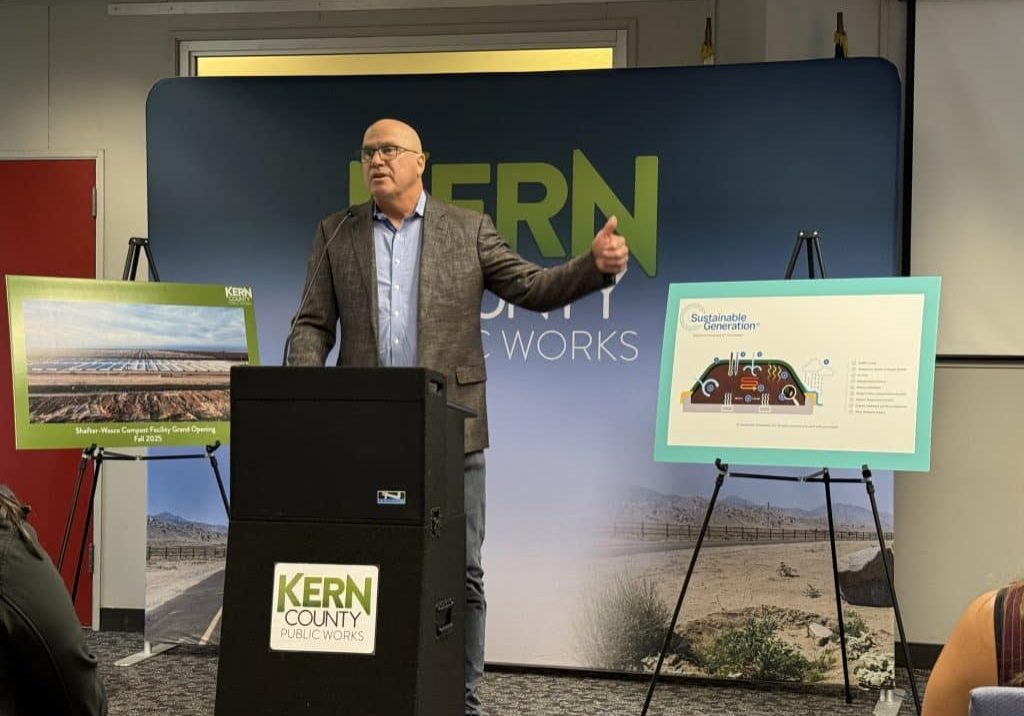
Building a Greener Future Together: Kern County Launches SG-Powered Compost Facility
Sustainable Generation is proud to celebrate the grand opening of the Shafter-Wasco Compost Facility
Making Waves, the Membrane Covered ASP Composting Tsunami
ASP composting relies on forced aeration to maintain aerobic conditions and optimize biological activity.
INTERVIEW WITH A BIOSOLIDS EXPERT
Biosolids expert Dan Collins, P.E., shares insights on safe, efficient composting.
Summary of Performance GORE® Cover and Negative ASP
GORE® Cover was evaluated to quantify the performance versus an existing negatively aerated static
Composting Facility Delivers Significant Environmental Protection
The East Coast’s largest food waste composting site processes 57,000 tons of organics annually.
Exceeding Air Quality VOC Emission Regulatory Compliance in California
SG systems consistently meet and exceed California air quality regulations.
Positive ASP Composting: the Future of Organics
Two of the biggest issues faced by commercial composting operators are emissions (odor and
Proven Results: Over 20 Years Reducing Odors and Emissions in California
Sustainable Generation, LLC and the GORE® Cover have a long track record of success.
Why Smart Composting Facility Operators Keep Stormwater and Leachate Separate
During heavy storms, composting facilities face increased runoff and leachate.
What our customers are saying…

“The Sustainable Generation® team provided us with outstanding hands-on assistance as we learned to use their system. We retrofit our existing positive air ASP system, which used a compost cap, by upgrading to the SG Mobile® System with GORE® Cover so we could address environmental and community concerns about odors and vector control, and also so we could scale up and expand our composting operation."
Justin Green, Executive Director & Founder Big Reuse

"With disposal and transportation costs increasing with no end in sight, plus an abundance of yard debris from our community, we decided to try biosolids composting at our Wastewater Treatment Plant to reduce our costs and create a Class A product. We went with the SG Mobile® System with GORE® Covers. The ease of operation and the cost savings made this a natural fit. The final product has been a huge hit with the locals who can't get enough Class A compost. We recently doubled the size of our composting operation to keep up with our increasing volumes and demand. This system is easily scalable to meet future demands."
Mike Miller, Public Works Director, City of Florence, Oregon

"We had no composting experience, so conducting a demonstration project with Sustainable Generation® greatly enhanced our understanding of food waste composting and helped us immensely with our subsequent expansion design process. During the selection process, it made a difference that SG's technology was already a proven solution for meeting VOC emission reductions for our San Joaquin Valley Air Pollution Control District."
Jonathan Kalpakoff, VP Mid Valley Disposal
“The Sustainable Generation® team provided us with outstanding hands-on assistance as we learned to use their system. We retrofit our existing positive air ASP system, which used a compost cap, by upgrading to the SG Mobile® System with GORE® Cover so we could address environmental and community concerns about odors and vector control, and also so we could scale up and expand our composting operation."
Justin Green, Executive Director & Founder Big Reuse
"With disposal and transportation costs increasing with no end in sight, plus an abundance of yard debris from our community, we decided to try biosolids composting at our Wastewater Treatment Plant to reduce our costs and create a Class A product. We went with the SG Mobile® System with GORE® Covers. The ease of operation and the cost savings made this a natural fit. The final product has been a huge hit with the locals who can't get enough Class A compost. We recently doubled the size of our composting operation to keep up with our increasing volumes and demand. This system is easily scalable to meet future demands."
Mike Miller, Public Works Director, City of Florence, Oregon
"We had no composting experience, so conducting a demonstration project with Sustainable Generation® greatly enhanced our understanding of food waste composting and helped us immensely with our subsequent expansion design process. During the selection process, it made a difference that SG's technology was already a proven solution for meeting VOC emission reductions for our San Joaquin Valley Air Pollution Control District."